Understanding Your Bill

What You Need to Know
The hospital billing process may seem complicated, but you can feel more in control by knowing exactly what your bill covers. For example, if you stay overnight, you can expect to see charges for your room, meals, 24-hour nursing care, and medicines. The bill will also show charges for any special services, such as X-rays and lab tests. You’ll receive bills for doctors, surgeons, and specialists separately from the hospital.
Medicare
If you have Medicare, you may have to fill out an MSP (Medicare Secondary Payer) form. This ensures that Medicare only pays for services not covered by other insurance you may have. If you have secondary insurance, this usually covers Medicare deductibles. If you don’t have secondary insurance, you need to pay these amounts yourself.
Also be sure to read your quarterly MSNs (Medicare Summary Notices) to review:
- the amount your doctor(s) charged
- the amount Medicare approved and paid
- the amount you owe
- your current deductible status
If you have questions, call the customer service number listed on your statement.
Commercial Insurance Providers
If you use a commercial insurance provider, then the hospital forwards your claim based on the information you provide at registration. About a month after you leave the hospital, you’ll get an explanation of benefits (EOB) statement from your insurance provider. This isn’t a bill.
EOBs show:
- the amount billed by your doctor or hospital
- how much of that cost is covered by your insurance
- how much you owe
Review this and all other bill-related documents carefully. If you have questions, contact your doctor or the customer service number listed on the statement.
Self-Pay Patients and Payment Arrangements
If you’re planning to pay your bills without help from Medicare or a commercial insurance provider, then you’ll get bills directly from the hospital. Self-pay patients have the right to receive a "good faith" estimate before a planned hospital stay. To learn more, visit cms.gov/nosurprises.
When the first bill arrives, call the hospital’s financial services department to set up a payment plan. Communicate with the financial services department as soon as possible. If you don’t set up a payment plan, or if you stop making payments, then your account may be placed with a collection agency. The hospital wants to work with you, so reach out with any questions or concerns you have.
Northwell Health Financial Assistance Policy Plain Language Summary
At Northwell Health (Northwell), we are committed to providing the best care possible for all of our patients and to increasing access to high-quality clinical care in the communities we serve. We understand that, as a patient, you may feel stressed to receive a hospital bill. That is why we have created a robust financial assistance policy at our hospitals and hospital-based clinics. You may qualify for help if you are unable to pay all or part of your bills for emergency or other medically necessary care.
We have a large staff of trained financial counselors ready to assist you if you believe you need financial assistance. We encourage you to use the contact information listed below to contact Northwell and ask to speak to a financial counselor to see if you qualify. Northwell financial counselors may also be able to help you obtain health care insurance available to you.
Summary of Northwell Health’s Financial Assistance Policy
Eligible services
You may be eligible for financial assistance for emergency medical care and other medically necessary services provided and billed by Northwell Health’s hospitals. These services include physician services in these hospitals provided by physicians who are employed by Northwell Health. A sliding fee discount is also available for medically necessary services provided to uninsured patients in a Northwell hospital clinic.
If you are a New York state resident, you may qualify for financial assistance or the sliding fee discount if you submit an application and if we determine that you are eligible. You may be eligible if you have no health insurance, or if you are otherwise unable to pay. If you do have health insurance, you may still be eligible if you have out-of-pocket expenses that you are not able to pay. Factors that will determine your eligibility for financial assistance are discussed below.
How to apply for financial assistance
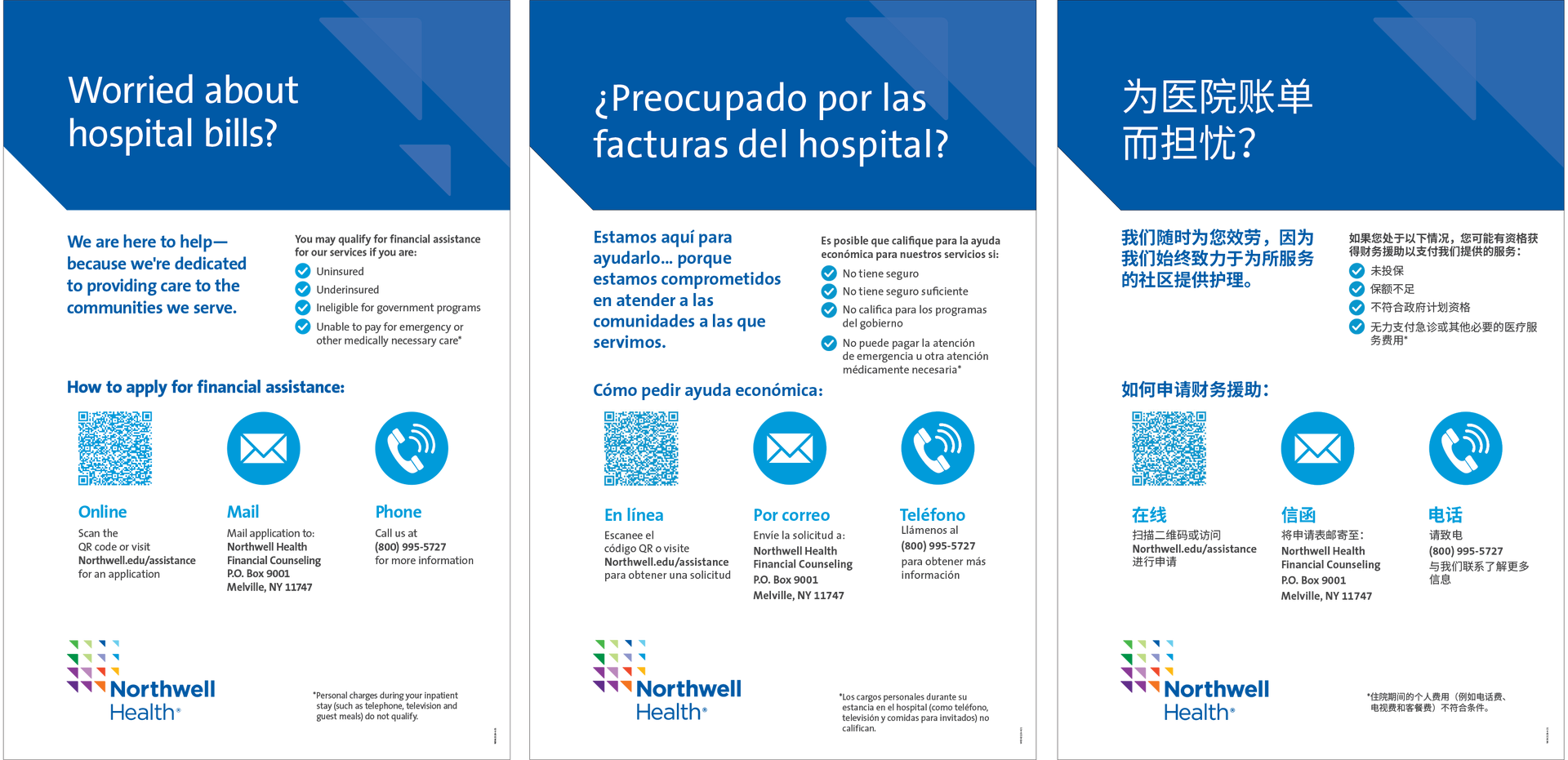
Submit a complete financial assistance application with all required documentation online, via mail, or by working with one of Northwell Health’s financial counselors over the phone. You can get an application in any of the following ways:
- online at the Northwell Health website: https://www.northwell.edu/billing-and-insurance/financialassistance-
- programs-policies/financial-assistance-program
- at each Northwell Health hospital facility’s main registration desk or emergency room desk, or at the
- applicable clinic
- by contacting Northwell at the contact listed below and asking to speak with a financial counselor
If you are a hospital patient, we encourage you to apply for financial assistance as soon as possible and within 90 days from the date on your first post-discharge billing statement. Note, however, that you can submit a financial-assistance application at any time after you are treated at the hospital.
If you are a new patient at a hospital clinic, we encourage you to submit your application before your first appointment, or to bring the materials necessary to submit an application to your first appointment.
If you submit an incomplete application, we will notify you and give you an opportunity to provide any missing information or documentation.
Determination of eligibility
Eligibility for financial assistance is based on family income and, in some cases, on other information you provide. If after reviewing your application, Northwell determines that your income is at 500% of Federal Poverty Guidelines (FPG) or below, you will be eligible for a discount on your bill for eligible services. Greater discounts are provided for lower levels of income. In 2024, the maximum income levels for eligibility at 500% of FPG are shown below:
| Household/Family Size | Maximum Family Income (500% of 2024 Federal Poverty Guidelines)* |
|---|---|
| 1 | $75,300 |
| 2 | $102,200 |
| 3 | $129,100 |
| 4 | $156,000 |
| 5 | $182,900 |
| 6 | $209,800 |
| For each additional person, add | $26,900 |
*These guidelines are from 2024 but will be updated every year.
If your family income is less than or equal to 200% of the FPG, you may qualify for free hospital or hospital clinic care. If your family income is between 201% and 500% of the FPG, you may qualify for partial financial assistance. If eligible, you will not be billed more than the amount generally billed to insured persons for the care provided.
For non-English speakers
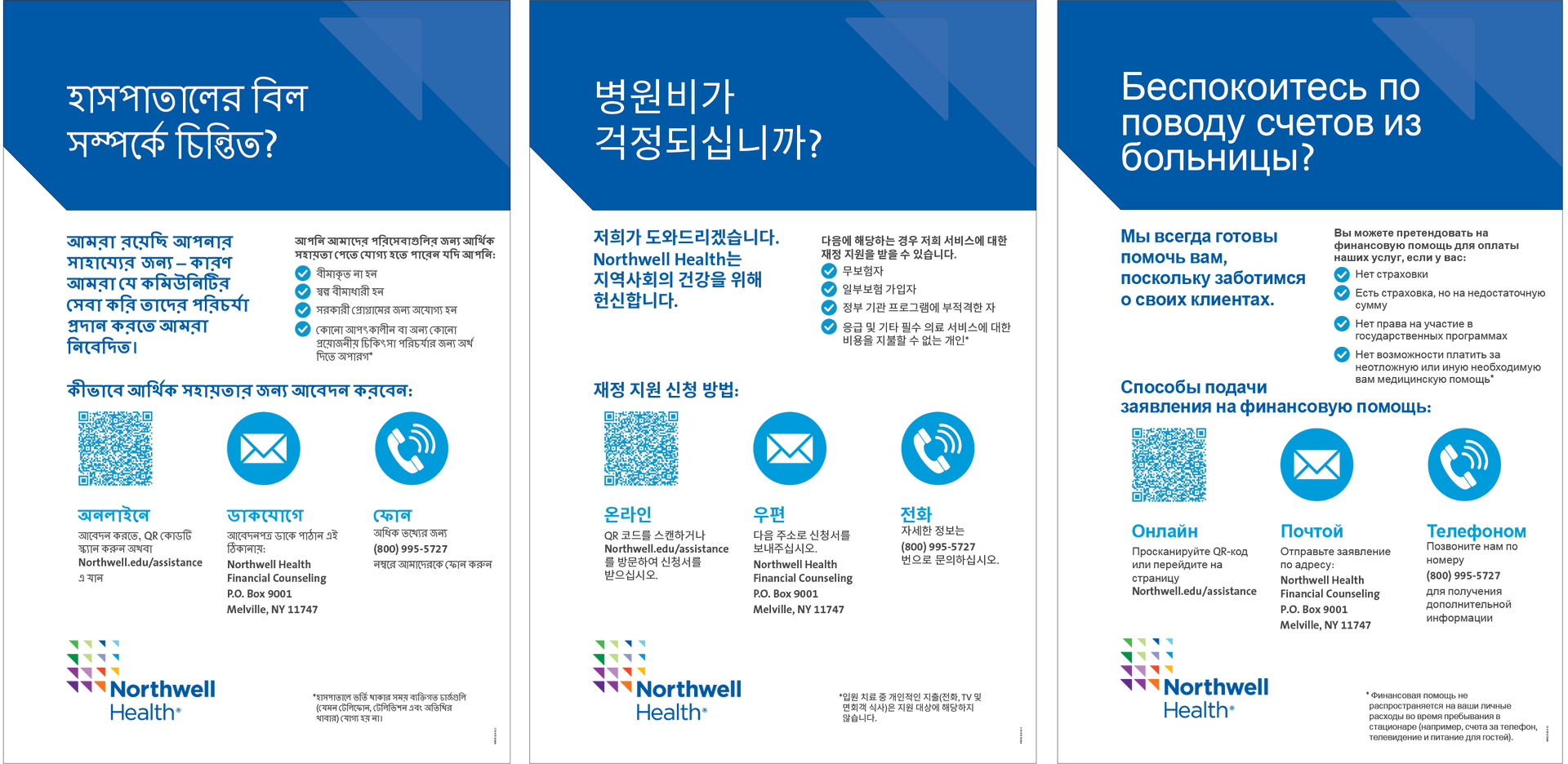
Find translations of our financial assistance policy, our application for financial assistance, and this plain language summary online at https://www.northwell.edu/billing-and-insurance/financial-assistanceprograms-policies/financial-assistance-policy or request a copy.
Contacts for questions about financial assistance or for help completing an application
All Northwell hospitals and hospital clinic sites except Peconic Bay
Most Northwell Health hospitals or hospital clinic sites
For: North Shore University Hospital, Long Island Jewish Medical Center, Long Island Jewish Forest Hills, Long Island Jewish Valley Stream, Cohen Children’s Medical Center, Zucker Hillside Hospital, Huntington Hospital Association, Lenox Hill Hospital, Manhattan Eye, Ear and Throat Hospital, Staten Island University Hospital, Glen Cove Hospital, Plainview Hospital, South Shore University Hospital, Syosset Hospital
Phone: 1-800-995-5727
Walk-in address: Northwell Health
Financial Assistance Unit
2 Huntington Quadrangle, Suite 4S01
Melville NY 11747-9001
Mailing address: Northwell Health
Financial Assistance Unit
P.O.B. 9001
Melville NY 11747-9001
John T. Mather Hospital
Phone: 631-313-7712
Mailing address: Financial Assistance Department
75 North Country Road, 1st floor
Port Jefferson NY 11777-2190
Northern Westchester Hospital
Phone: 914-666-1512
Mailing address: Financial Assistance Unit
400 East Main Street
Mount Kisco NY 10549-1096
Phelps Memorial Hospital Center
Phone: 914-366-3004
Mailing address: Financial Counseling
701 North Broadway
Sleepy Hollow NY 10591-1096
Peconic Bay Medical Center (note different website address)
Phone: 631-548-6099
Mailing address: Financial Assistance
1 Heroes Way
Riverhead NY 110901
Website: www.pbmchealth.org/admissions/billing/financial-aid
Commonly Confused Terms
- Deductible: The amount you owe each year before your insurance begins making payments.
- Co-payment: A flat fee you pay for a specific service, usually due at the time of service.
- Coinsurance: The portion of your medical expenses that you’re personally responsible for paying.
Keeping Track
One of the key ways to feel well-informed and less overwhelmed about the hospital billing process is to stay organized. Keep all of your statements and bills together, and review each one as it arrives.
Understanding Coordination of Benefits (COB)
COBs happen when you’re covered under two or more insurance companies. This may occur when spouses or partners are listed on each other’s insurance policies, or when both parents carry their children on their individual policies.
To prevent duplicate payments, COBs determine the primary payer. Your insurance providers follow guidelines to choose who pays first. Check with your insurance provider about their rules for COBs, primary payers and forms to fill out.
Need Help?
If you don’t understand something on your bill, or if you’re having trouble paying your bills, let us know. A patient representative can work with you.